GUIDE · APO-05
Solar storm preparedness
A Carrington-class geomagnetic storm is a rare, real, mapped event. This guide summarizes what is known, what breaks first, and what an ordinary household can do before and during.
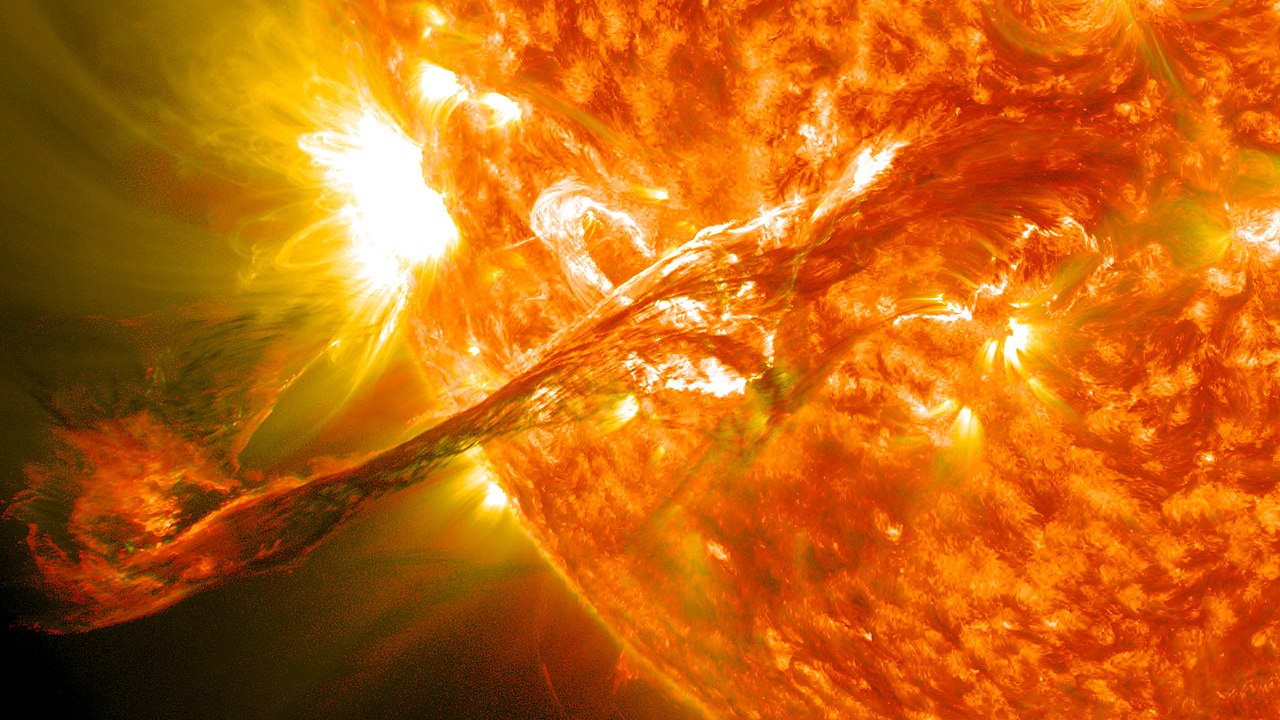
What a solar storm is
A coronal mass ejection (CME) hurls magnetized plasma from the Sun. If it strikes Earth, induced currents circulate through long conductors — transmission lines, pipelines, signal cables — and can saturate high-voltage transformers. Useful warning between L1 detection (ACE/DSCOVR satellites) and arrival is typically 15 to 60 minutes.
Calibrated precedents
- 1859 — Carrington Event. Aurorae seen in the Caribbean; telegraphs caught fire, some operated without batteries.
- 774–775 CE — Miyake event. Tree-ring carbon-14 spike consistent with a solar event larger than Carrington.
- 1989 — Quebec. Province-wide 9-hour blackout from geomagnetically induced current.
- July 2012 — A Carrington-scale CME crossed Earth's orbit; the planet had passed that point ~9 days earlier.
What breaks first
- High-voltage transformers (345 kV+). Replacement: 6 to 24 months; limited global spare stock.
- Low-orbit satellites and GPS. Signal degradation, increased atmospheric drag, loss of fine positioning.
- HF radio and polar comms. Blackout within minutes, recovery within hours.
- Distribution grids at high latitudes before equatorial ones.
What a household can do beforehand
- Two reference scenarios: 72 hours without grid and 2 weeks without grid. Prepare for the second, live for the first.
- Water: 4 liters per person per day. Mechanical filter + purification tablets as redundancy.
- Lighting: hand-crank or solar torch; candles only as a third option.
- AM/FM radio, battery or hand-crank, for the official bulletin. HF only if you already operate it.
- Documents and small-denomination cash; ATMs and card readers stop with the grid.
- Cooking fuel (gas, alcohol) for 14 days of simple preparation.
- Chronic medication with 30 days of buffer; insulin cooled in a thermal bag with reusable ice.
During the warning window (15 to 60 minutes)
- Unplug sensitive electronics: computers, router, TV, residential solar inverters.
- Do not open freezer or fridge without need; a closed freezer holds food 24 to 48 hours.
- Fill water containers while pressure lasts.
- Top up batteries, phone, torches.
- If you operate essential vehicles (ambulance, rescue), park where it does not depend on electric fuel pumps.
What this guide is not
This is not a long-term survival plan, nor a public infrastructure proposal. Structural mitigation — DC blockers on transformers, substation hardening, strategic spares — is the responsibility of utilities and regulators. This guide covers 14 days, not fourteen years.
Technical sources
- NOAA Space Weather Prediction Center — G1 to G5 scale and operational bulletins.
- NASA / ESA — CME and solar wind modeling.
- Miyake et al. (2012) — Nature. Carbon-14 spike in 774–775 CE.
- Baker et al. (2013) — Space Weather. Analysis of the July 2012 CME.
- Hydro-Québec — report on the March 13, 1989 blackout.
